Engine Internals
This page orients researchers and contributors to ProofFrog’s internals: the overall pipeline, the canonicalization mechanism, the introspection commands for diagnosing failing hops, and the LSP/MCP interfaces. It complements the user-facing Canonicalization page, which describes what the engine does from a proof-author’s perspective; this page describes how it does it. For the broader design of ProofFrog and its canonicalization approach, see the ProofFrog paper and thesis, both listed on the Publications page.
- High-level architecture
- The transformation pipeline
- Advantage-bound synthesis
- Engine introspection commands
- LSP and MCP servers
- Appendix: transform catalog
High-level architecture
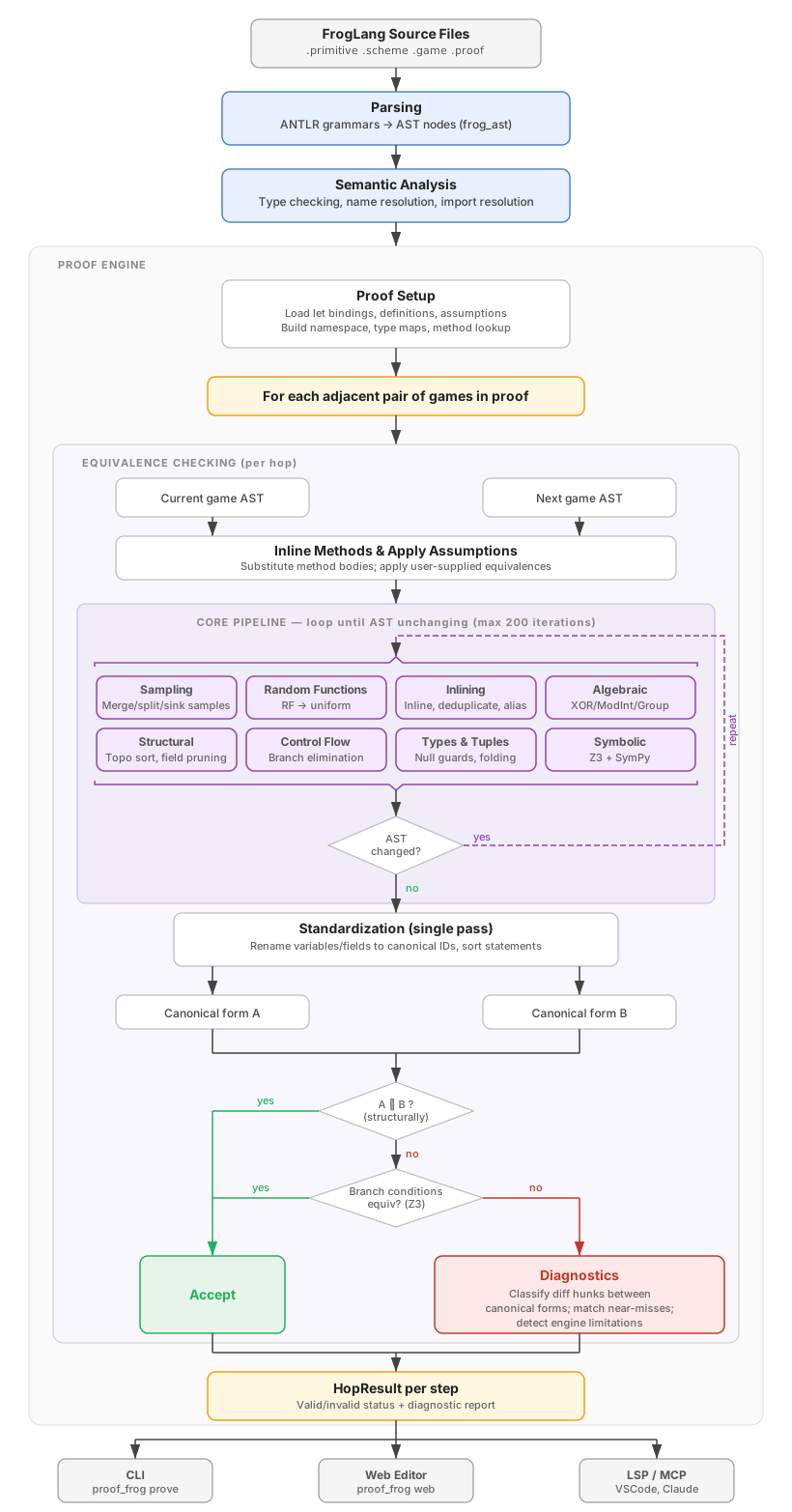
ProofFrog is a pipeline: source files are parsed from FrogLang syntax into abstract syntax trees (ASTs), those ASTs are type-checked by the semantic analyzer, and verified proofs are checked step by step by the proof engine. For each adjacent pair of games in the games: block of a .proof file, the engine (a) instantiates both game expressions against the proof’s let: bindings, (b) inlines the scheme methods named in those expressions, and (c) runs the canonicalization pipeline on each resulting game AST independently. If the two canonical forms are structurally identical the interchangeability hop is accepted; if they differ only in logically equivalent branch conditions the engine also queries Z3. Reduction-based hops are accepted by checking that the stated assumption appears in the proof’s assume: block. The canonicalization step is itself a two-stage process: a fixed-point loop (CORE_PIPELINE) that iterates until the game AST stops changing, followed by a single-pass normalization (STANDARDIZATION_PIPELINE) that renames variables and fields to canonical identifiers.
The transformation pipeline
For the user-facing model of what these transforms achieve, see the Canonicalization page.
Pipeline assembly
Canonicalization runs in two stages. The first stage is a fixed-point loop: an ordered list of transformations is applied in sequence, then the entire sequence is repeated from the beginning, until a full sweep produces no change. If the loop does not converge within a generous iteration bound, a warning is emitted and processing continues with the last state reached.
The second stage is a single-pass normalization that runs once after the first stage converges. It renames local variables and fields to canonical identifiers, sorts field assignments, and stabilizes independent statements. Because it runs only once, its passes must be idempotent.
Transform categories
The transforms that make up the fixed-point core stage are grouped by the class of simplification they perform. Each source file under proof_frog/transforms/ in the ProofFrog repository defines one or more transforms in a given category. The appendix at the bottom of this page gives a one-line summary of every individual transform.
- Alpha-renaming — a global pre-pipeline pass that gives every typed local binder a fresh, globally unique name. It runs first in
CORE_PIPELINEand exists to make the passes after it safe; see below. - Algebraic identities — arithmetic and bitstring identities: XOR cancellation and identity, boolean simplification, commutative-chain and concatenation-chain normalization, modular arithmetic folding, group-element exponent arithmetic, and decomposition of equalities between concatenations, injective-function calls, and tuples into their component parts.
- Uniform sampling — uniform random sampling and splice normalization: merging and splitting samples, propagating slices through concatenation, sinking samples later in a block, and converting init-only or single-use fields into local variables.
- Random functions —
Function<D, R>random-function elimination: lifting random-function calls into named temporaries, recognizing fresh/distinct/unique inputs, replacing calls with uniform samples when the inputs are provably distinct (including through injective encoding wrappers), and recognizing aMap<K, V>used as a lazily-populated random oracle and rewriting it into a sampledFunction<K, V>. - Map iteration — rewriting a
for ... in M.entriesscan that looks up a matching key into a direct map lookup, so scan-style and index-style lazy tables canonicalize the same way. - Map re-indexing — re-keying a lazy map whose key is a consistent injective wrapping
w(x)to use the inner valuexdirectly (via the shared injective-wrapper recognizer protocol). - Inlining and common-subexpression elimination — variable, field, and expression inlining; common-subexpression elimination; cross-method field aliasing; and hoisting of group-exponent and deterministic-call computations into
Initialize. - Control flow — branch and dead-code elimination; conditional merging and guard factoring; normalization of equivalent
if/elseand early-return arrangements; return-statement simplification; Z3-backed unreachability and return-branch folding. - Structural ordering — field and statement ordering: topological sort with dead-code elimination, field unification and pruning, uniform-bijection elimination.
- Symbolic integer arithmetic — integer sub-expression simplification via SymPy.
- Type-driven simplifications — null-guard elimination and subset-type normalization.
- Tuples — tuple index folding, expansion, collapsing, and
[a[0], a[1], ..., a[n-1]]reconstruction.
Two further groups of transforms run outside the fixed-point core stage. The standardization passes form the single-pass second stage described above, renaming locals and fields to canonical identifiers, sorting field assignments, and stabilizing independent statements. The assumption-application pass is invoked by the proof engine only when an explicit assumption annotation appears between two games in a proof, and substitutes the user-supplied equivalence pairs between variables.
Why alpha-renaming runs first
FrogLang’s block scoping is position-sensitive: a name used before its local declaration binds to the enclosing scope — a game field, an outer local, or a parameter — and only from the declaration point onward does it bind to the local. So in
Int out = x;      // reads the FIELD x (the local x is not declared yet)
Int x = 0;        // declares the local x
return out + x;   // reads the LOCAL x
the two occurrences of x denote different things. This mirrors the typechecker’s scope stack, which adds a typed binder to the current scope only after visiting its right-hand side.
That rule interacts badly with passes that rewrite code by splicing or reordering block-local declarations — BranchElimination splicing the body of an if (true) into its parent block, or SimplifyIf normalizing branches. If a body-local shadows an outer local or a field, a name-blind rewrite conflates the two bindings, and the engine can certify a hop that a distinguisher refutes. Two such soundness failures were found in the 2026 audit.
AlphaRename removes the collision at the root rather than teaching each pass to avoid it. It gives every typed local binder a fresh globally-unique name, rewriting exactly the references that resolve to it under position-sensitive scope, so no later pass has a same-name collision to mishandle. Only local binders are touched: fields, method parameters, game parameters, and proof-let:/scheme/primitive names are left alone. Loop binders are not renamed but are masked in the loop body, so a same-named outer local cannot leak in. The pass skips names already carrying its reserved prefix, which makes it idempotent on its own output and safe to sit inside the fixed-point loop.
Because every renamed binder is typed, the post-pipeline VariableStandardize pass re-washes them all to the canonical v1, v2, … names. Canonical forms are therefore unchanged by the pass’s presence — it buys soundness for the passes in between at no cost to what two games are compared as.
Reporting failures to the user
The engine has two complementary mechanisms for explaining why an interchangeability hop failed.
The first is near-miss reporting. At any point where a transform almost fires but cannot because some syntactic or semantic precondition does not hold, it records a near-miss: a note carrying the transform’s name, a human-readable reason, an optional source location, an optional suggestion for the proof author, and optional variable and oracle-method identifiers. After the pipeline completes, the engine joins collected near-misses against the diff between the two canonical forms by method name and variable presence, so that it can tell the user “this simplification would have fired here except for X.”
The second mechanism handles failures in regions where no transform ever attempted to simplify. There the engine falls back to a small set of detectors for known gaps in the canonicalization pipeline — cosmetic patterns the algorithm does not currently normalize, such as commutativity and associativity of boolean operators or reordering of independent if/else-if branches. When one of these detectors matches the diff, the failure is reported as an engine limitation with a suggested workaround rather than being left unexplained. The full list of known limitations, together with their user-facing workarounds, is on the Limitations page.
Advantage-bound synthesis
proof_frog/advantage.py implements the machinery behind the Advantage bound: line and the bound: clause. For the user-facing account, see Advantage Bounds. Structurally it is three tiers.
Tier 1 — synthesis. A pure fold over a verified proof’s hop_results (or over the proof AST directly, via synthesize_from_steps), composing the triangle-inequality sum of per-hop losses into a SymPy expression over opaque Adv_i symbols. Equivalence hops contribute 0; assumption and lemma hops contribute one term each, with repeats collapsing to k * Adv^X(B) and distinct reductions numbered B1, B2, and so on. The engine supplies the per-hop bookkeeping — justification, reduction, direction — on each HopResult. Tier 1 runs no transforms and calls neither Z3 nor SymPy’s solver; it is arithmetic over data the proof run already produced. Inductive proofs are reported as unsupported rather than approximated.
Tier 2 — statistical helper bounds. When a by_assumption hop’s notion resolves to a helper .game file carrying a declared advantage <= ...; clause, resolve_statistical substitutes the clause’s game parameters from the assumption instantiation and replaces the opaque term with the concrete expression. Set cardinalities stay opaque positive symbols. The clause’s per-oracle query counts are derived rather than assumed: _derive_oracle_count statically counts how often the composed reduction invokes each oracle, with a call in Initialize counting once, a call in any other reduction method counting count_<method> times (that method being an oracle of the theorem game), loops multiplying, and if branches summing as an upper bound. The result is a bound stated in the theorem game’s own query counts. An integer calls <= N cap in assume: pins the surviving counts to N, which is sound because these bounds are monotone in the counts.
Tier 3 — checking a claim. check_claimed_bound matches each advantage(...) reference in the proof’s bound: clause to a synthesized term by exact (notion, reduction) identity; an unmatched reference becomes a fresh nonnegative symbol, which can only add slack and so cannot produce a false pass. It then decides whether claimed - synthesized >= 0 over the nonnegativity region, using SymPy for the easy cases and falling back to Z3 over the reals (_sympy_to_z3, _decide_nonnegative). The real region is a superset of the integer domain the quantities actually inhabit, so a non-negativity proof there is sound for the intended domain. Symbolic exponents, a Z3 unknown, or a timeout yield undecided — never verified. The three-valued result is verified / not_verified (which fails prove unless --skip-bound, and prints a witness) / undecided (which warns only).
On the AST side, the parser wraps a claim in frog_ast.ClaimedBound, kept opaque to the generic name-resolution and type-check walk via Visitor.should_descend — the same treatment AdvantageClause gets. NameResolutionVisitor._check_claimed_bound validates well-formedness separately: that each named reduction is declared by the proof and composes the notion it is paired with, and that each count_ names a real theorem oracle.
Engine introspection commands
Four CLI commands are intentionally excluded from the CLI Reference because they target contributors and MCP/LSP clients rather than end users. All four output JSON and are the CLI equivalents of the corresponding MCP tools documented in CLAUDE_MCP.md in the ProofFrog repository.
step-detail <file> <step_index>
Loads the proof file, instantiates and inlines game step step_index (zero-based), runs the full canonicalization pipeline, and prints a JSON object whose key fields are:
canonical— the fully simplified game AST as a string. This is the field to read when writing a matching intermediateGamedefinition.output— the raw (pre-simplification) game AST with mangled internal variable names; ignore this field.success—falseif the step index is out of range or an error occurred.has_reduction,reduction,challenger,scheme— metadata about whether the step involves a reduction and what its components are.
Comparing the canonical output of step i against step i+1 directly shows any remaining difference.
proof_frog step-detail examples/joy/Proofs/Ch2/OTPSecure.proof 0 | python -m json.tool
inlined-game <file> <step_text>
Reads the let:, assume:, and theorem: blocks from the proof file and constructs a minimal scratch proof in which step_text is the only game in the games: list, then evaluates that scratch proof’s step 0. Unlike step-detail, the step does not need to appear in the actual proof file, and stub reductions that prevent parsing do not interfere. This makes it the primary tool for writing intermediate games: you can explore arbitrary game expressions against the proof’s let: context before committing any of them to the file. The returned JSON has the same canonical, output, and success fields as step-detail.
proof_frog inlined-game examples/joy/Proofs/Ch2/OTPSecure.proof \
  "OneTimeSecrecy(E).Left against OneTimeSecrecy(E).Adversary" | python -m json.tool
canonicalization-trace <file> <step_index>
Runs the canonicalization pipeline for the given proof step using run_pipeline_with_trace and returns a JSON object containing success, iterations (an array of {iteration, transforms_applied} objects, one per iteration in which at least one transform changed the AST), total_iterations, and converged (whether the pipeline converged before the 200-iteration limit).
This is the first diagnostic to reach for when a hop is failing and near-miss output is not enough: it shows the exact sequence of transforms that fire and the order in which they reduce the game, making it straightforward to identify which simplification is missing.
proof_frog canonicalization-trace examples/joy/Proofs/Ch2/OTPSecure.proof 1 \
  | python -m json.tool
step-after-transform <file> <step_index> <transform_name>
Applies the canonicalization pipeline up to and including the named transform (first iteration only, using run_pipeline_until) and returns the game AST at that point. The response JSON contains success, output (the AST as a string after the named transform), transform_applied (whether the named transform actually changed the AST), and available_transforms (the full list of valid names, useful when the supplied name is not recognized).
This enables single-step debugging: apply transforms one by one and inspect the intermediate AST to determine exactly where a simplification should have fired but did not.
proof_frog step-after-transform examples/joy/Proofs/Ch2/OTPSecure.proof 1 \
  "UniformXorSimplification" | python -m json.tool
LSP and MCP servers
LSP server
ProofFrog ships with a Language Server Protocol implementation, started by proof_frog lsp. It listens on stdio and is compatible with any LSP-aware editor; see Editor Plugins for the VSCode plugin configuration. Other editors need only a thin client pointing at proof_frog lsp as the server command.
The server implements the standard LSP features over FrogLang source: parse and semantic diagnostics, go-to-definition, hover, context-sensitive completion and signature help, document symbols for the Outline panel, local-symbol rename, and folding ranges. The server caches the most recently successfully parsed AST for each open document, so that completion, hover, and symbols continue to work even while the document currently has syntax errors.
On save, the server runs the full proof engine against the file and surfaces the results back to the editor as inline code lenses — a green check or red cross next to each game in the games: block. The VSCode extension additionally uses a custom notification to populate its proof-hops tree view with per-step results; other clients can ignore that notification and rely on the code lenses alone.
MCP server
ProofFrog also exposes its capabilities as Model Context Protocol tools for LLM-based proof authoring. Start the MCP server with proof_frog mcp [directory], where the optional directory argument sets the working root from which all file paths are resolved; a path-safety check prevents tools from reading or writing files outside that directory or inside hidden subdirectories. The server communicates over stdio and requires the optional MCP extra (pip install 'proof_frog[mcp]').
The server exposes the following tools:
| Tool | Description |
|---|---|
version | Report the installed ProofFrog version |
list_files | Browse .primitive, .game, .scheme, .proof files as a nested tree |
read_file | Read a ProofFrog file by path |
write_file | Create or overwrite a file; parent directories are created automatically |
describe | Compact interface summary (parameters, fields, signatures, no bodies) |
parse | Syntax check; returns {output, success} |
check | Semantic type-check; returns {output, success} |
prove | Full proof verification; returns {output, success, hop_results} |
get_step_detail | Canonical form of a proof step (use canonical field, not output) |
get_inlined_game | Canonical form of an arbitrary step expression against the proof’s let: context |
get_canonicalization_trace | Which transforms fired at each fixed-point iteration |
get_step_after_transform | Game AST after transforms up to a named pass |
It also exposes a prooffrog://language-reference MCP resource containing a concise FrogLang syntax reference that an LLM can fetch without reading through example files.
The MCP-oriented tool-usage guide and setup instructions are in CLAUDE_MCP.md in the ProofFrog repository. For a practical introduction to using the MCP server to iteratively write and debug proofs with Claude Code, see the Gen AI & Proving page.
Appendix: transform catalog
This appendix contains a one-line summary of every transform in proof_frog/transforms/, grouped by source file. The authoritative ordering is in pipelines.py.
AlphaRename— gives every typed local binder a fresh globally-unique name, under position-sensitive scope. Runs first inCORE_PIPELINE; see Why alpha-renaming runs first.
UniformXorSimplification— uniformBitString<n>XOR’d with an expression used only in that one XOR becomes a fresh uniform sample (one-time pad).UniformModIntSimplification— theModInt<q>addition analogue.UniformGroupElemSimplification— the group-element scalar-multiplication analogue.XorCancellation—x + xbecomes the zero bitstring.XorIdentity—x + 0^nbecomesx.ModIntSimplification— folds constant modular arithmetic (identity, zero, inverse) via SymPy.NormalizeCommutativeChains— sorts XOR,+, and*operand chains into a canonical order; also normalizes==/!=operand order.FlattenConcatChain— left-associates||chains (sound under both Boolean OR and BitString concatenation).ReflexiveComparison—x == x→true,x != x→false.BooleanIdentity— boolean AND/OR with literaltrue/false.BooleanAbsorption— drops a conjunctBfrom anA && Bchain whenA’s flat OR-disjuncts are a subset ofB’s.SimplifyNot—!(a == b)→a != b,!(a != b)→a == b.GroupElemSimplification,GroupElemCancellation,GroupElemExponentCombination— group-element exponent arithmetic (power-of-power, identity rules, term cancellation, and same-base exponent combination).InjectiveEqualitySimplify—f(a..) == f(b..)→ component-wise&&(and!=to the disjunction) whenfisdeterministic injective.ConcatEqualityDecompose— decomposes an equality involving a concatenation into pairwise slice equalities when component lengths are derivable.TupleEqualityDecompose— rewritesa != bon tuples to the per-component disjunction of!=(the==direction is intentionally left atomic).
SimplifySplice— propagates slices through concatenation, collapsing(a || b)[0:n]when boundaries are static.MergeUniformSamples— mergesBitString<n>andBitString<m>samples used only via concatenation into oneBitString<n+m>.MergeProductSamples— the product (tuple) type analogue.SplitUniformSamples— the inverse: splits aBitString<n>into independent samples per non-overlapping slice.SingleCallFieldToLocal— converts an init-written, single-oracle-read field into a local variable.CounterGuardedFieldToLocal— converts counter-guarded (write-once) fields into local variables.SinkUniformSample— moves uniform samples as late as possible within a block to expose further simplifications.LocalizeInitOnlyFieldSample— converts a field sampled only inInitializeand never written again into a local there.SliceOfInlineConcat— rewrites a slice of a concatenated variable to the underlying component when the slice bounds line up with the concat boundaries.
ExtractRFCalls— lifts random-function calls out of expressions into named intermediate variables.UniqueRFSimplification— calls on<-uniq-sampled inputs each return an independent uniform sample.ChallengeExclusionRFToUniform— recognizes challenge-exclusion even through an injective encoding wrapper.LocalRFToUniform— a single-oracle-local random function called on a fresh input becomes a uniform sample.DistinctConstRFToUniform— statically distinct constant inputs yield independent uniform samples.FreshInputRFToUniform— a<-uniqinput used only in one RF call (bare, in a tuple, or in a concatenation) becomes a uniform sample.LocalFunctionFieldToLet— unifies a game-local sampledFunction<K, V>field with an identically-typed let-bound random function when the latter is otherwise unused in the game.LazyMapToSampledFunction— rewrites aMap<K, V>field used exclusively as a lazy random oracle into a sampledFunction<K, V>field.LazyMapPairToSampledFunction— generalizes the above to a pair of maps used jointly through the guarded-pair lazy-lookup idiom.
LazyMapScan— rewrites afor e in M.entries { if e[0] == k { return e[1]; } }scan over a lazy map into a directM[k]lookup, given uniqueness of map keys.
MapKeyReindex— re-indexes a lazy map whose key is a consistent injective wrapperw(x)to use the inner valuexdirectly; uses the shared_wrappers.pyrecognizer protocol.
RedundantCopy— removesx = ywhenyis not later modified.IfSplitBranchAssignment— moves trailing statements into if/else branches when every branch assigns the same variable.InlineSingleUseVariable— substitutes at the single use site and drops the binding.DeduplicateDeterministicCalls— introduces a common temporary for duplicate calls to adeterministicmethod.HoistDuplicateBranchCall— hoists a deterministic call duplicated across exclusive branch returns into one local before the branches.ForwardExpressionAlias— forward-propagates a never-reassigned pure RHS to all uses.HoistFieldPureAlias— replaces reads of a field always equal to a pure expression with the expression.CrossMethodFieldAlias— propagates adeterministiccall result stored in a field across oracle boundaries.HoistDeterministicCallToInitialize— hoists a deterministic call out of oracles intoInitializeand caches it in a new field.SplitOpaqueTupleField— splits a tuple-typed field whose RHS is an opaque call and whose reads are constant-indexed projections into one field per used component.HoistGroupExpToInitialize— hoistsbase ^ kgroup exponentiations intoInitializeand caches them in a pinned field (requires a prime-order / nonzero-exponentrequires:context).RefactorGroupElemFieldExp— rewritesbase ^ (a * b)asField2 ^ bwhen a pinned fieldField2 = base ^ aexists, exploiting(g^a)^b = g^(a*b).InlineSingleUseField— inlines the write into the read site when a field is written and read exactly once (skipping pinned fields); a cross-method variant extends this when the expression is pure with stable field free vars.ExtractRepeatedTupleAccess— extracts repeatedvar[constant]accesses into named locals (CSE for tuple destructuring).InlineLocalTupleLiteral— substitutes a[..] v = [..]tuple-literal local through its constant-index accesses.InlineMultiUsePureExpression— inlines a pure expression at multiple uses when it does not duplicate non-determinism.CollapseAssignment— collapses a declaration followed by a reassignment into one statement.RedundantFieldCopy— removes intermediate locals used only to assign to a field.
IfConditionAliasSubstitution— substitutes field references with local aliases inside equality-guarded if-branches (including tuple-alias guards).GuardConditionSimplification— replaces a deterministic guardCwithtruein its then-branch andfalsein its else-branch.IfToBooleanAssignment— collapsesif (C) { x = true; } else { x = false; }tox = C;(and the negated form).RedundantConditionalReturn— removesif (c) { B } BwhenBunconditionally returns and is immediately followed by an identical copy.AbsorbRedundantEarlyReturn— absorbs a duplicated earlyreturn X;into a following guard as a conjunction.FactorCommonGuard— transposes a P-first nested guard into V-first form, factoring a shared inner guard (P deterministic, V write-free).MergeNestedGuard— mergesif (P) { if (Q) {..} TAIL } TAILintoif (P && Q) {..} TAIL.DeadGuardedAssignmentElimination— replacesv = Ewithv = falsewhen the store is reached only under conditions entailing a later guardG.IfFalseReturnToConjunction— absorbsif (P) { return false; } ... return Q;into... return Q && !P;.BranchElimination— eliminates branches whose conditions are literaltrue/false.UniqExclusionBranchElimination— statically eliminatesx in Sbranches whenxwas sampled via<-uniq[S]andSis unchanged since.ElseUnwrap— unwraps an else block when the if-branch unconditionally returns.SimplifyReturn— collapsesType v = expr; return v;toreturn expr;.SimplifyIf— merges adjacent if/else-if branches with identical (alpha-equivalent) bodies.RemoveUnreachable— Z3-backed dead-statement elimination after unconditional returns.FoldEquivalentReturnBranch— foldsif (P) { return X; } return Y;toreturn Y;when Z3 provesP ⇒ (X ↔ Y)(refuses on non-deterministic calls).
TopologicalSort— reorders statements by data dependency, with dead-code elimination for no-effect statements.RemoveDuplicateFields— unifies two same-type fields that provably share the same value.RemoveUnnecessaryFields— deletes fields not contributing to any oracle’s return value.UniformBijectionElimination— a uniform sample composed with an injective function becomes a fresh sample of the output type.
SymbolicComputation— integer sub-expressions round-tripped through SymPy for algebraic simplification.
DeadNullGuardElimination— removesif x != Noneguards when the type system already guarantees non-null.SubsetTypeNormalization— normalizes subset-type expressions to the underlying base type where semantics allow.
FoldTupleIndex—[a, b, c][1]→bwhen the index is a compile-time constant.ExpandTuple— rewrites a tuple into per-index variables when all accesses use constant indices.SimplifyTuple— collapses[a[0], a[1], ..., a[n-1]]intoa.CollapseSingleIndexTuple— scalarizes a tuple accessed only at one constant index.NormalizeProductLiteral— normalizesProductTypetuple literals appearing in expression (value) positions, fixing their Z3 encoding. Declared types —the_typeslots, sample spaces, loop variable types — are deliberately left untouched.
StandardizeParameters— canonicalizes oracle parameter names, so that two games differing only in what an oracle calls its argument canonicalize together.VariableStandardize— renames locals tov1,v2, … in order of first appearance.StandardizeFieldNames— renames game fields to canonical names by oracle first-read order, then regroups by type so α-equivalent games agree on field numbering.BubbleSortFieldAssignments— sorts the field assignment block into a stable canonical order.StabilizeIndependentStatements— reorders independent statements canonically (Kahn topological sort).FieldLexMinByRHS— within each same-type field group, picks the lex-smallest slot for the field with the smallest Initialize-RHS key; runs at the end of the pipeline (after the finalVariableStandardize) so RHS keys see final local names.
ApplyAssumptions— applies user-supplied equivalence pairs between variables. Not in the core pipeline; invoked by the engine when an assumption annotation appears between two games.